HackUMass · Nov 2026
Pluto: answers from your course notes, cited to the page
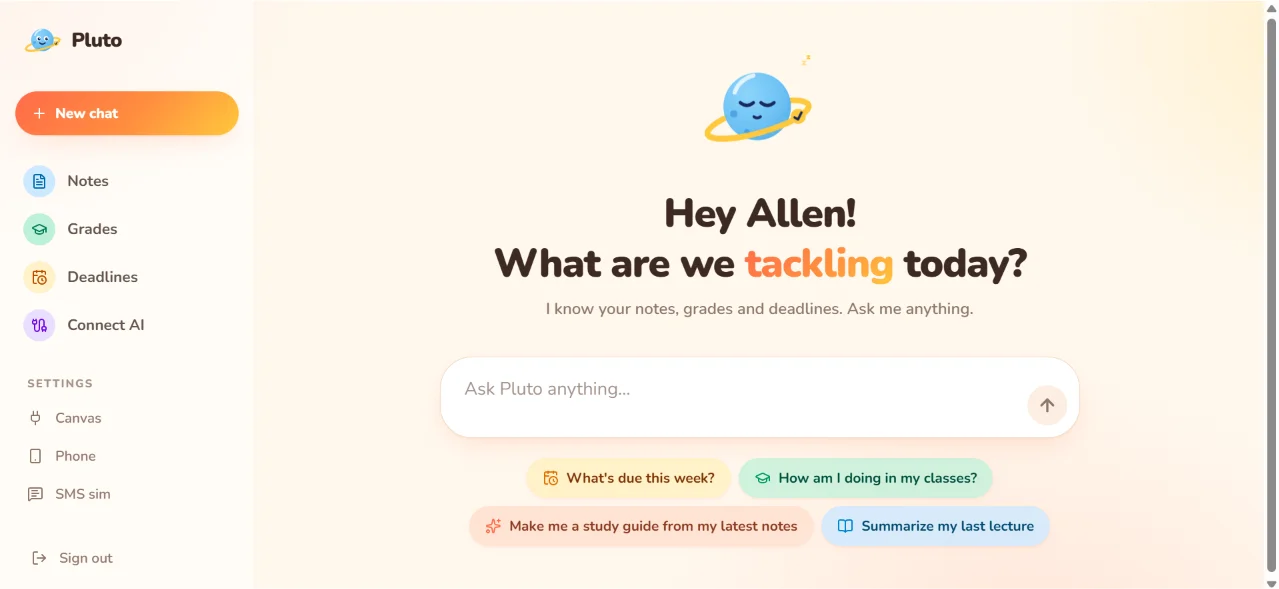
An AI study assistant that reads your Canvas courses and answers from Claude, ChatGPT, the web or SMS, citing the exact PDF page.
- Context
- HackUMass, Nov 2026. Live demo and public repo.
- My role
- Product owner and director of a team of AI coding agents
- Stack
- Next.js, Tailwind, Supabase (Postgres full-text search, Auth, Storage), TypeScript MCP SDK, Gemini, zod, Vitest
- Try it
- pluto-sepia.vercel.app (opens in a new tab), then “Try the demo”. No sign-up.
- Next.js
- MCP
- OAuth 2.1
- Postgres FTS
- Gemini
The problem
Course material is scattered across Canvas pages, PDFs and due dates, and AI chat tools can't see any of it. Students end up pasting slides into ChatGPT and hoping the answer matches the lecture.
What it does
- Syncs a student's Canvas courses, weighted grades, assignments and lecture PDFs.
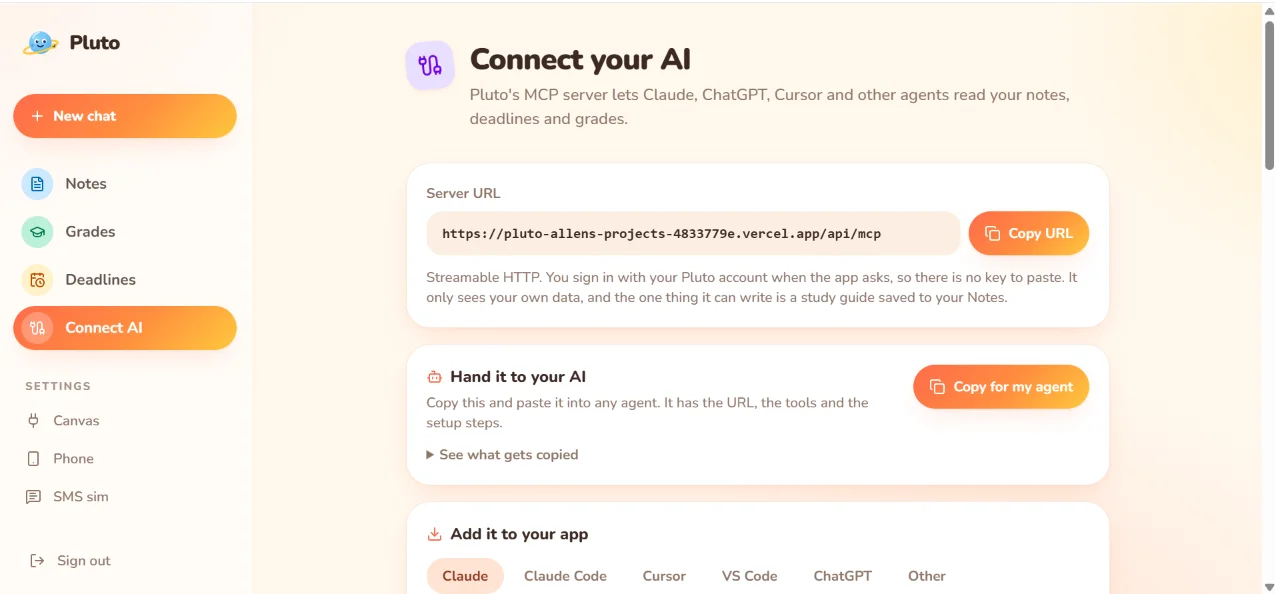
- Answers questions from the web, by text message, or from inside Claude, ChatGPT and Cursor over MCP.
- Every answer links to the exact PDF page it came from.
- Shows the running grade per course and flags deadlines that moved.
Try this in Claude once Pluto is connected: “Build me a study guide from my History 105 notes from the past 2 weeks, use Pluto.” Claude reads the notes, writes the guide with a page link behind every fact, and saves it to the Notes page.
How it's built
packages/core)- MCP tools served over OAuth 2.1, with Postgres full-text search for page-level retrieval.
- Row-level security on every table plus a
student_idfilter on every query; tests check that one student can't read another's data. - Canvas tokens are encrypted with AES-256-GCM. Magic-link and phone-link codes are stored only as hashes.
- The agent treats tool output as untrusted data and only cites pages that tools actually returned.
How I built it
I directed a team of AI coding agents (Claude and Cursor) over the hackathon. A director agent owned the plan and the shared contract, coders each worked in their own git worktree, CI ran typecheck, lint and database tests, and a fresh reviewer checked every security-sensitive change before it merged.
The briefs, plans and review reports are public in the repo's orchestrations folder (opens in a new tab), so you can see exactly how the work was split and checked.